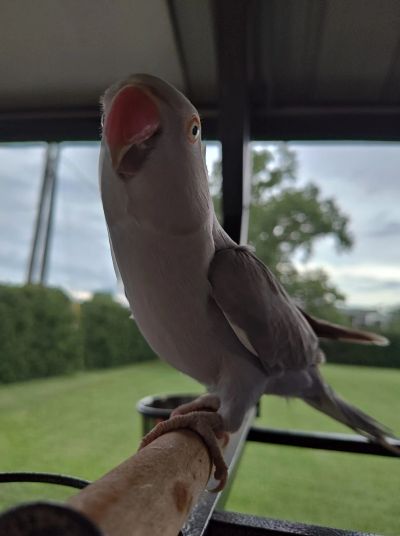
Understanding and Managing Bluffing in Indian Ringnecks
When an Indian Ringneck enters a bluffing or biting phase, the most important response is patience and consistency. Continue interacting with the bird normally while avoiding dramatic reactions to nipping or biting. Do not yell, strike, spray, tap the beak, shake your hand, or use other physical forms of punishment. These methods do not teach a Ringneck what you want it to learn. Instead, they can create fear, damage trust, and potentially turn a temporary behavioral phase into a long-term biting problem.
The objective is not to "defeat" the bird. It is to teach the bird that biting does not control the interaction while simultaneously maintaining a relationship built on trust.
Pay attention to the bird's body language and respect its limits. Some days your Ringneck may be more irritable, defensive, or unwilling to interact. Giving the bird appropriate space during those moments can prevent unnecessary confrontations. Confidence develops when the bird learns that its human is predictable, calm, and safe.
Overreacting to a bite can unintentionally make the behavior more significant. Likewise, completely isolating the bird whenever it becomes difficult can prevent it from learning appropriate ways to communicate. The better approach is to remain calm, adjust the interaction when necessary, and reinforce desirable behavior.
Your voice should be associated with positive experiences—conversation, reassurance, praise, and affection—not intimidation.
Reducing Opportunities for Biting
Some Ringnecks provide obvious warnings before they bite; others can be much less predictable. Learning your individual bird's signals is one of the best ways to prevent unnecessary bites.
Keep a favorite toy, treat, or other appropriate distraction nearby during interactions. If your Ringneck appears particularly excitable or defensive, redirecting its attention can prevent the situation from escalating.
Avoid deliberately testing the bird when it is clearly communicating that it does not want to participate. A Ringneck that turns away, moves away, pins its eyes, raises its feathers, opens its beak, or otherwise communicates discomfort is giving you valuable information. Listening to those signals is part of responsible handling.
If a bird bites and maintains its grip, remain as calm as possible and avoid turning the incident into a dramatic confrontation. Safely disengage and give the bird an opportunity to settle. The goal is to teach through consistency rather than punishment.
Patience Is Part of the Process
A temporary biting phase can be frustrating, particularly when a previously affectionate young Ringneck suddenly seems like a completely different bird. It is important to remember that behavioral development is not always linear.
Do not assume that a bird exhibiting aggressive behavior has permanently changed.
At the same time, do not assume that every biting Ringneck is simply "bluffing." Pain, fear, hormonal changes, environmental stress, inadequate socialization, learned behavior, and other factors can contribute to biting. Responsible caretakers should consider the whole bird rather than automatically assigning every behavioral change to one developmental stage.
During periods of increased biting, take sensible precautions. Keep the bird away from your face, supervise interactions carefully, and use additional caution around children or inexperienced handlers.
With patience, appropriate boundaries, and consistent positive interaction, many young Ringnecks mature into remarkably gentle and affectionate companions.
Every Ringneck Is an Individual
Not every Indian Ringneck experiences a pronounced bluffing phase.
The intensity and duration can vary considerably between individual birds. Some may display increased nipping for only a short period, while others may go through months of challenging behavior.
Sex alone does not determine whether a bird will bite or experience a particular behavioral stage. A biting Ringneck is not automatically female, and a female Ringneck is not destined to become a biter.
The most important lesson is to stop viewing the bird as an opponent that must be corrected.
An Indian Ringneck is an intelligent, independent animal communicating with the tools available to it. Our responsibility is to learn what that communication means.
The goal is not simply to make the bird stop biting.
The goal is to help the bird learn that humans are safe, predictable, and worth trusting—and to build a relationship in which neither the bird nor the human needs to rely on fear.